
Multimedia technologies with plastic interventions.
March 13, 2019
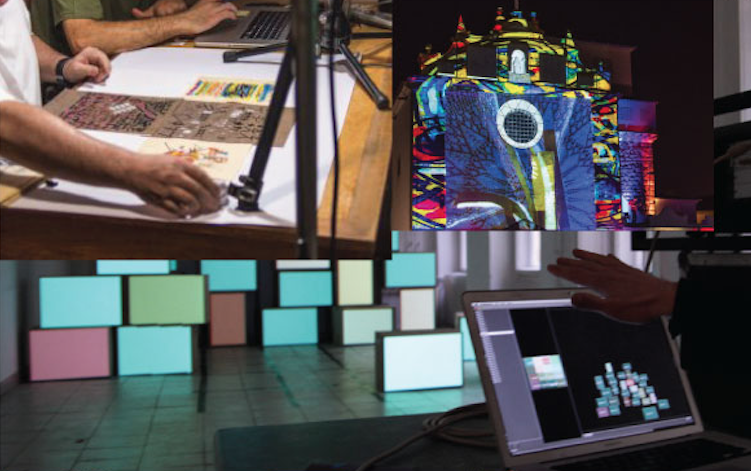
After the presentation of the event “O Cante Acusmático de Pias” with videomapping on the façade of the Church of Salvador, at the opening of the arts program Artes à Rua (Évora, July 12, 2018), a performance was executed using plastic arts techniques to provide a multimedia act of organic characteristics. It have resulted in real-time dynamic action, a performance sense that tries to bring multimedia, formerly conditioned in its digital and virtual conditions, closer to the human field, improvised, tactile and emotional.
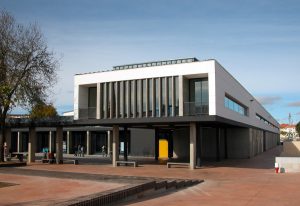
In the continuity of our artistic program we find it to be essential to pass this practice in order to arrive at new forms in the hands of many, which brings us to this workshop in response to the project of ‘Évora – Educating City – Artes a Escola’ (Arts to School), which we hope will be quite fruitful .
On this day some teachers and students of the arts courses received us and we had the joy of sharing knowledge and trying out new forms of expression.
Equipment we have been using:
- Camera DSRL ( Canon 550D – USB to computer)
- Tripod or rack that allows the camera to be fixed vertically over the table
- Computer with extra monitor output (we used a macbook)
- Camera Live: Software for streaming cameras (mac)
- Syphon: Program for live image transmission between applications
- Camtwist: Software for real-time video effects
- VPT: video mapping and control software (with image, video, syphon)
- Table with area for plastic performance
- Illumination from at least 2 sides, of white light (+6.000 k)
- Projector video (10,000 lumens to event) (4,500 lm) lenses according to the projection distance (Throw ratio)
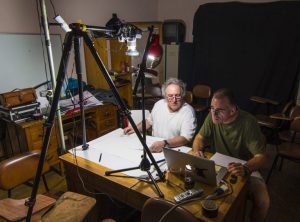
We were very pleased with the interest and imagination of the group of students who attended the workshop. In the theoretical introduction we were able to describe our missive of experimentation, which is based on the search for plastic acting in the technological forms of expression. We have described in some detail methods and the technological paraphernalia with its sequence of connections.
Some theoretical approach to the history of this type of performative art, namely in relation to the local universe that also has had its artists that accompanied artistic movements outside borders.
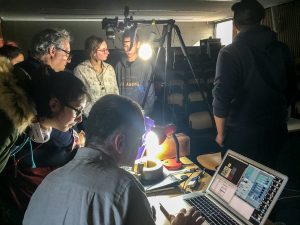
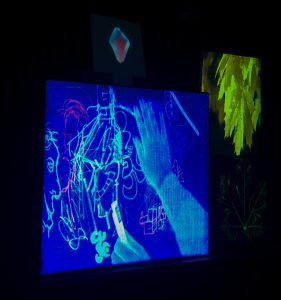
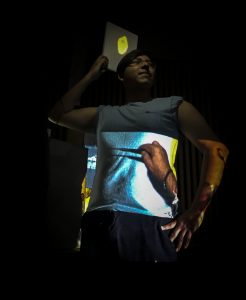
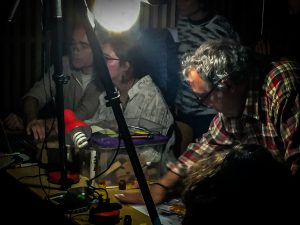
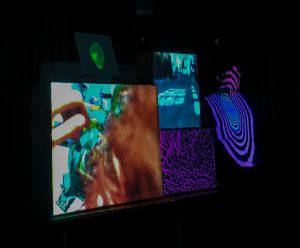
Netx, we went to the experimentation with students in which very interesting visuals were produced, using such different media as acrylic to alcohol inks, paper, oils on water, body projection and have build a small stage mounted with different volumetrics. The images were processed in real time which allows variations on the graphic compositions produced. It is work that only reaches to its full extent if it is participatory and promote the synchrony between performers.
 |
 |
 |
 |
|
|
 |

We hope to get the experience repeated, and we’re making contacts with other schools to extend to other students and teachers. These extra-curricular exercises brings opportunities for reciprocal formation, exchange of ideas that lead all participants to increase their creative intent, so necessary for the individual’s capacity for response in the dynamic world in which we live.
Our thanks to the teachers Leonor Serpa Branco, Ana Teresa Fialho and Jorge Firmino, also to the teacher Cristina Maia for her photographic look and to all the students who collaborated, Susana Russo and the Education Division of Évora City Hall.
A project organized following the work of the OFICINA•DO•ESPIRITO – artists collective, in my person and Feliciano de Mira.
Session’s auxiliary document (in portuguese):
OE-ArtesaEscola2019_docs.apoio

- OFICINA•DO•ESPIRITO